
When the Machine Trades for You: Understanding the Difference Between Manual and Automated Trading
Understand the key differences between manual and automated trading, from speed and execution to consistency and scalability and which approach suits your strategy best.
5/8/20246 min read
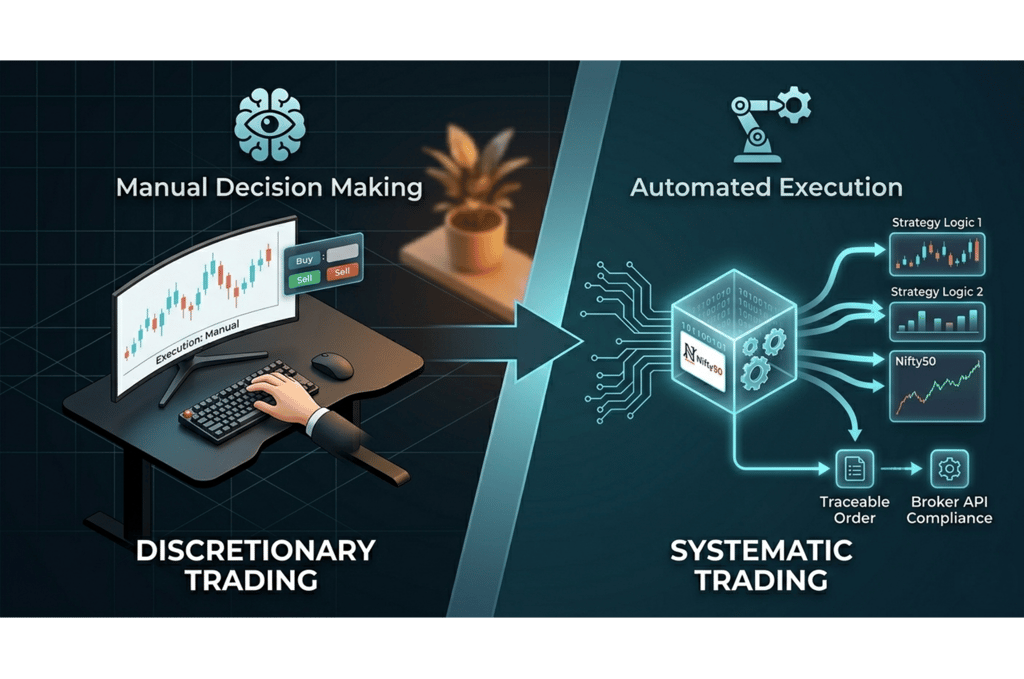
Let’s picture a speed camera on a highway. The moment a vehicle crosses the threshold, say, 108 km/hr in a 100 km/hr zone, the camera captures the plate, the speed, and the location. No human is standing there making a judgment call. The rule is set in advance, and the system enforces it the instant the condition is met.
A traffic officer doing the same job manually would face an impossible task. At that speed, with that volume of vehicles, human reaction simply cannot keep up with what the machine handles automatically.
Markets work the same way. Prices move in fractions of seconds. A setup that looks clean on a chart can be gone before a trader finishes placing the order. That gap between recognising an opportunity and acting on it is where the comparison between manual and automated trading becomes worth examining seriously.
How Manual Trading Actually Works
In manual trading, every decision flows through the trader. You watch the chart, read the indicators, form a view on where price is likely to go, size the position, decide on an entry level, and execute the order yourself. Nothing happens unless you make it happen.
Let’s take a straightforward example. A trader is watching the Nifty 50 on an intraday chart. Price has pulled back to a support zone which is a level where buyers have previously stepped in. The RSI is cooling around 40, suggesting the momentum has eased without collapsing. The trader reads this as a reasonable risk-reward setup and buys a call option expecting the support to hold.
Every part of that sequence, identifying the level, reading the indicator, sizing the position, deciding the entry price, and pressing the buy button, runs entirely through one person's judgment in real time.
The genuine advantage here is adaptability. If a macro event hits mid-session or the support cracks unexpectedly, the trader can pull back or reverse the view on the spot. That kind of contextual flexibility is difficult to replicate in a rule-based system.
The trade-off, however, is demanding. Manual trading requires unbroken attention for as long as you are in the market. A distraction at the wrong moment, a hesitation after a losing trade, or a decision coloured by frustration, any of these can quietly unravel an otherwise disciplined approach.
How Automated Trading Works
Now return to the speed camera. It does not watch for speeding vehicles in the way a police officer might, scanning the road, making judgments, reacting. It simply waits for the predefined condition and responds the instant that condition is satisfied.
Automated trading applies the same logic to financial markets. The trader defines a set of rules upfront. The system monitors the market continuously and fires the order the moment those rules are met, without hesitation, without second-guessing, and without needing anyone at the screen.
Using the same Nifty 50 scenario from earlier, the automated version might look like this:
"Enter a long call option when price pulls back to the predefined support zone, the RSI reads around 40, and price shows signs of holding above that level. Place a stop loss below the support zone. Exit when price reaches the next resistance level."
Once those conditions are defined and deployed, the system watches every candle and every tick. When the setup appears, it acts exactly as specified, every single time.
The trader builds the logic once. The system runs it every session.
Where the Two Approaches Diverge
The differences between manual and automated trading are not just about speed. They run through every part of how a strategy is executed.
Order execution in manual trading is trader-dependent and naturally prone to delays and slippage. In an automated system, orders are rule-triggered and near-instant; the gap between signal and fill is measured in milliseconds.
Decision-making in manual trading relies on the trader's real-time judgment, which is subject to fatigue, distraction, and emotional state. An automated system follows predefined logic regardless of what happened in the previous trade or how the session is going.
Emotional influence is perhaps the most significant differentiator. A losing streak before a valid setup introduces doubt. A profitable run introduces overconfidence. Both distort execution in ways that are genuinely difficult to catch at the moment. A rule-based system operates entirely outside this dynamic; past trades have no bearing on whether the next order goes through.
Market monitoring is effectively unlimited for an automated system. A trader at a screen can realistically track one or two setups before attention begins to slip. An automated system can simultaneously watch multiple instruments, timeframes, and conditions without any degradation in performance.
Testing a strategy is also fundamentally different. Manual trading performance is hard to measure objectively; results are shaped by too many variables that cannot be isolated. An automated strategy can be run in a virtual or simulation mode on live market data, giving traders a clear read on how the logic behaves across different market conditions before any real capital is committed.
Finally, running multiple strategies simultaneously is simply not feasible for a manual trader managing more than one or two positions. For an automated system, scaling across instruments is a structural feature rather than a challenge.
The Advantages of Automation
Execution speed:
Between a condition being met and the order going through, there is virtually no delay in an automated system. In derivatives markets especially, where prices can move across strikes within seconds, that gap matters considerably.
Consistency under pressure:
The system does not have bad days. It does not carry the weight of yesterday's losses into today's session. Whatever the logic says, that is what gets executed.
Parallel monitoring:
A single automated system can watch dozens of instruments at once, something no individual trader can match regardless of experience.
Testability:
Strategies can be validated in virtual mode using live market conditions before real capital is deployed. Running the logic through trending periods, sideways consolidation, and sudden volatility spikes tells a trader far more about whether the approach actually holds than backtesting alone.
Reduction in operational errors:
Wrong strike price, incorrect lot size, a missed exit because attention shifted; these are common in manual trading. Automation removes most of them. The system executes precisely what was defined.
Continuous monitoring without continuous presence:
Once a strategy is live, the system handles the watching. The trader does not need to be at the screen for every tick.
Why Automated Trading Is Growing in India
Several factors have converged to drive adoption among retail traders in India.
Derivatives markets have grown significantly, and instruments like options move fast. Delayed execution is not just a minor inconvenience in these markets; it is a structural disadvantage that compounds over time. Automated strategies address this directly.
The technology barrier has fallen considerably. No-code platforms now allow traders with a clearly defined strategy and genuine market understanding to build, test, and deploy systematic approaches without writing a single line of code. What once required a developer can now be handled independently.
The regulatory environment has also become more structured. SEBI's 2025 circular on retail algorithmic trading introduced clearer rules around order traceability, risk controls, and accountability, giving participants a more defined framework to operate within.
And awareness has grown. Trading communities, educational content, and accessible resources have shortened the learning curve. More retail traders are now entering systematic trading with a working understanding of rule-based approaches, rather than having to figure it out from scratch.
Who Is Automated Trading Actually Suited For?
There is no version of this where one approach is universally better.
Manual trading remains the right choice for discretionary traders whose edge depends on reading conditions that are genuinely difficult to codify; scalpers, traders who rely heavily on market context, and those who find that their judgment in specific situations consistently outperforms any rule set they could articulate.
Automated trading suits traders who work with systematic, repeatable setups, who want to run strategies across multiple instruments simultaneously, or whose time during market hours is limited by other commitments. For professionals who cannot restructure their day around watching a screen, automation makes consistent market participation possible without that sacrifice.
Many experienced traders operate both in parallel, automated systems handling the repeatable setups, with manual judgment applied where context genuinely demands it.
What Actually Changes
The move from manual to automated trading is not about replacing skill with software. It is about applying skill differently.
A strong discretionary trader who understands markets and has a genuine edge does not lose that edge by automating it, they remove the variables that human execution introduces and gain consistency that is difficult to sustain manually over extended periods.
The prerequisite is being able to express the strategy as clear, unambiguous rules. If the logic can be stated precisely enough that a machine can follow it without interpretation, it can be automated. If it depends on a kind of intuition that resists articulation, it probably cannot; at least not yet.
That distinction is worth sitting with before making the move. Automation amplifies whatever is already in the strategy. If the logic is sound, consistency improves. If it is not, the system will simply execute the flawed logic more efficiently than a human would.
Help
Questions? Reach out anytime, we're here.
© 2026. All rights reserved.