
Algo Trading in India: How It Works and Where It Stands Legally
For decades, trading required human decisions in real time, but today, strategies can run independently, reacting to markets without constant supervision.
5/8/20244 min read
The Core Idea
At its core, automated trading is about encoding a decision into a set of rules. A trader decides in advance what conditions should trigger a buy or a sell; it might be a price threshold, a pattern formed by a technical indicator, a time-based trigger, or a combination of factors. Once those rules are locked in, a software system monitors the market continuously and acts when the conditions are satisfied.
The human element does not disappear entirely. The strategy still needs to be thought through, built, and occasionally reviewed. But the moment-to-moment execution is handled by the machine.
What this eliminates is one of trading's oldest problems: the gap between a signal and an action. That gap, even when it is just a few seconds wide, can be the difference between getting a fill at the right price and missing it entirely. Automated systems respond in milliseconds. Human traders simply cannot compete on that dimension.
Who Uses It and Why It Is Gaining Popularity
Not long ago, algorithmic trading was the exclusive domain of institutional players like hedge funds, proprietary trading desks, and large brokerages with the infrastructure and technical teams to build and maintain these systems. That gap has narrowed considerably.
Today, retail traders in India have access to broker APIs, no-code strategy builders, and automated execution tools that would have required a full engineering team a decade ago. Someone without a single line of code to their name can now build a rule-based strategy, backtest it on historical data, and deploy it on live markets; all through a single platform.
The lower cost of computing, the broader availability of market data, and the rise of user-friendly interfaces have combined to bring automated trading within reach of a much wider population.
From Strategy to Execution
The typical workflow follows a clear sequence. A trader identifies a market edge or hypothesis, perhaps a trend-following setup, a mean-reversion idea, or a volatility-based approach. That hypothesis gets translated into explicit, testable rules. The rules are built into a strategy on an automated trading platform. The platform then connects to the market through a broker and executes orders whenever the criteria are met.
The system continues monitoring the market without interruption. It does not get tired, distracted, or emotional. When the defined conditions appear, it acts and that consistency is what many traders find most valuable about automation.
The Legal Question
Automated trading in India is entirely legal. It operates under a well-defined regulatory structure, overseen by SEBI at the policy level and implemented through exchanges like NSE and BSE.
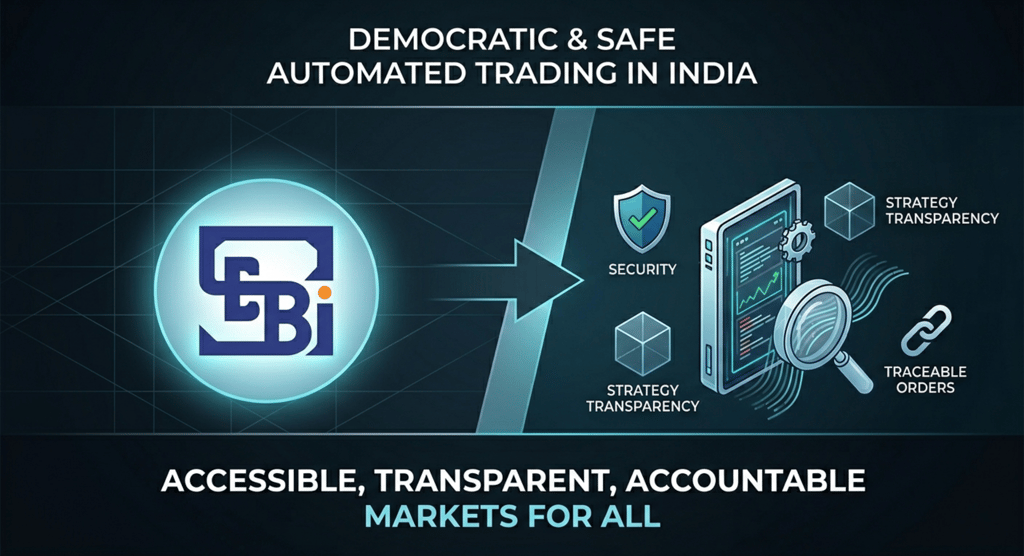
A significant development came in early 2025, when SEBI released a circular specifically addressing retail participation in algorithmic trading. The framework formalised how retail traders can engage with automated systems and introduced a set of safeguards to ensure transparency and accountability across the ecosystem.
What the 2025 Framework Actually Changes
Broker API access is now traceable:
Retail traders using automated systems can no longer connect to broker APIs in an unmonitored way. Approved channels are required, which means every automated order now has a documented origin.
Each automated order carries a unique identifier:
This makes it possible to trace any given order back to the strategy and system that generated it. This is a meaningful change in how algo activity is tracked at the transaction level.
Low-frequency retail strategies largely go unaffected:
Registration requirements only apply above a certain activity threshold. Most retail strategies operate well below that level and remain straightforward to run.
High-volume, high-frequency strategies require regulatory approval:
Speed-based strategies that generate large numbers of orders need to go through a formal clearance process before running on live markets.
Strategy transparency is now a regulatory category:
SEBI draws a distinction between strategies whose logic is fully visible called white box algos and those where the logic is hidden from the user are known as black box algos. Providers running black box systems must register as Research Analysts and maintain documented records of how those systems function. An unregistered, unexplained strategy has no place in a live trading environment under this framework.
Distributing a personal strategy requires approval:
A trader can build a strategy and trade it. Selling or sharing it with others without going through the proper process falls outside what the framework permits.
Brokers now share accountability:
Platforms and brokers enabling automated trading are required to actively monitor the activity running through their systems and maintain proper records. Compliance is not the trader's burden alone.
A Quick Read on How This Affects You
How the framework applies depends on how you trade.
If you are trading manually, nothing changes. The rules are specifically aimed at automated systems, and manual trading is untouched.
If you are already using or considering an automated setup, participation is allowed, but it needs to sit within the approved structure. That means using a compliant platform, confirming that any third-party software you rely on is properly approved, and making sure the logic behind your strategy is transparent enough to meet the white box standard if required.
The practical questions worth asking any platform provider are:
Is this system broker-compliant?
Has the software been approved under the SEBI framework?
Can the strategy logic be clearly explained?
The Bigger Picture
Regulation of this kind often gets read as restriction. In this case, it is closer to the opposite. The 2025 framework does not close off automated trading, it brings it into a structure that makes wider participation possible with greater confidence.
Retail traders now have both the tools to participate and a clearer set of rules governing how that participation works. That combination of accessible technology and a defined regulatory environment is what makes this a genuinely open space for anyone willing to learn how it works.
Modern no-code platforms have lowered the technical barrier to near zero. The regulatory framework has removed the ambiguity about what is and is not permitted. What remains is the work of building strategies that actually perform and that part has always been up to the trader.
Help
Questions? Reach out anytime, we're here.
© 2026. All rights reserved.